From Body Hulls to Musculoskeletal Models: Personalized Inertial Parameter Estimation
Show affiliations ▼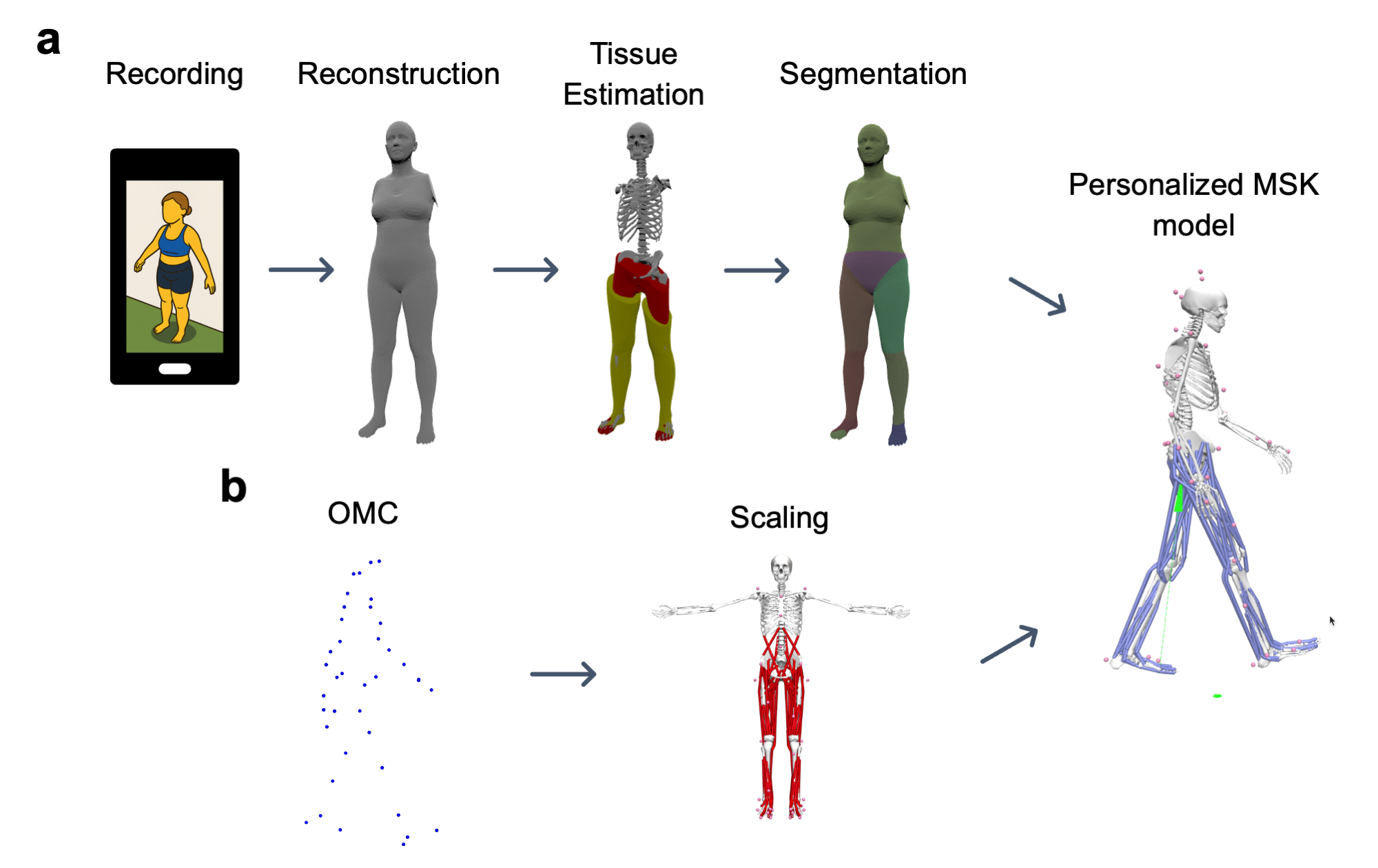
Abstract
Every human body is different, however, current movement analysis does not reflect that, as it heavily relies on generic musculoskeletal models. Usually, these models are scaled to match the participants’ body segment lengths and body weight, but not taking individual body shape into account. This can lead to errors in the estimation of joint forces and torques, which are important to accurately estimate musculoskeletal variables. Thus, we developed a method to estimate body segment inertial parameters based on body hulls acquired via smartphone pictures. From the body hull, we infer the skeletal shape and pose, and then estimate the distribution of bone, lean, and fatty tissues. We then segment the body hull and assign each tissue type a density, which is used to calculate the body segment inertial parameters. To allow for the use of our method with existing data, we also introduce two new generic musculoskeletal models, which are based on the average standing body shapes. Validation using MRI-derived ground-truth models shows that our method creates participant-specific musculoskeletal models that are closer to the MRI-derived ground truth than scaled generic models. Additionally, we performed lab-based gait experiments to evaluate the effect of our method on residual forces and joint moments, where we found that our method leads to a reduction of residual forces of up to 14.9% and a reduction of metabolic cost of up to 12.8% when compared to generic musculoskeletal models. Our new generic models show similar joint moment outcomes, but less reduction of residual forces than the personalized models.
SIPP - Shape-based Inertial Parameter Personalization:
Web App
We are developing a web application to allow users to create personalized musculoskeletal models using body hull recordings - no coding required!
Sign up for our web-app here!
Citation
If you find our work useful, please cite:
Contact
For questions or collaborations, please reach out to: